The Three-Week Loop: Why Physical AI Hasn’t Had Its Vibe-Coding Moment?
November 2026
Hardware is hard.
When AI writes software, the first build often fails with errors. That's fine. The AI reads the errors and fixes them right away. Hardware isn't like that. If an AI-designed board has a mistake, you find out after it's been fabricated, when it burns up the parts you waited 7 to 10 days to get from China. So there's no immediate dopamine.
I don't think AI got good at code because code is easy. I think it got good because code talks back. A compiler is a very good critic. It never gets tired, and it never tells you what you want to hear. Every run ends with a verdict: either it built, or here's line 41 and here's what's wrong with it. A model can read that, change one thing and try again, fifty times before lunch, at almost no cost. It's the loop that makes this work, and the code is more or less what falls out of it.
Hardware has a loop too, but it's three weeks long and it ends in smoke. And the error messages are terrible. A circuit with split grounds doesn't refuse to power on. It powers on and reads nonsense. A 5 V sensor on a 3.3 V pin works fine on Monday and has killed the pin by Friday. An LED without a resistor works for a moment and then burns out. Most hardware mistakes are silent, and you only find out about them when they've become expensive.
Now put AI into that loop. When AI gets something wrong, it usually gets it wrong in a confident, plausible way, like a pin number that sounds right or a part that almost exists. In software a mistake like that lasts about two seconds before the compiler catches it. In hardware it gets fabricated and shipped to you from the other side of the world.
So I don't think speed is the thing to work on. A model will already happily draw you a wrong board in a minute. What hardware needs is a compiler.
In practice, that means building the error messages hardware never gives you, and getting them before the factory instead of after it. The first is checking every pin against the board's real pinout, rather than trusting the model's memory of it. If a design's grounds don't meet, it should be refused, with a note saying which ones and why. The electrical and design-rule checks a professional would run should run every time. The firmware should be compiled for real and then actually run, the real binary on a simulated chip, so you can see what it does to its pins and what it prints. And before anyone solders anything, the circuit should be simulated.
Each of these checks turns what would have been a burnt part into a line of text. An AI can read a line of text and fix the problem in seconds, the same way it fixes a missing semicolon. You get the loop back, and with it the dopamine.
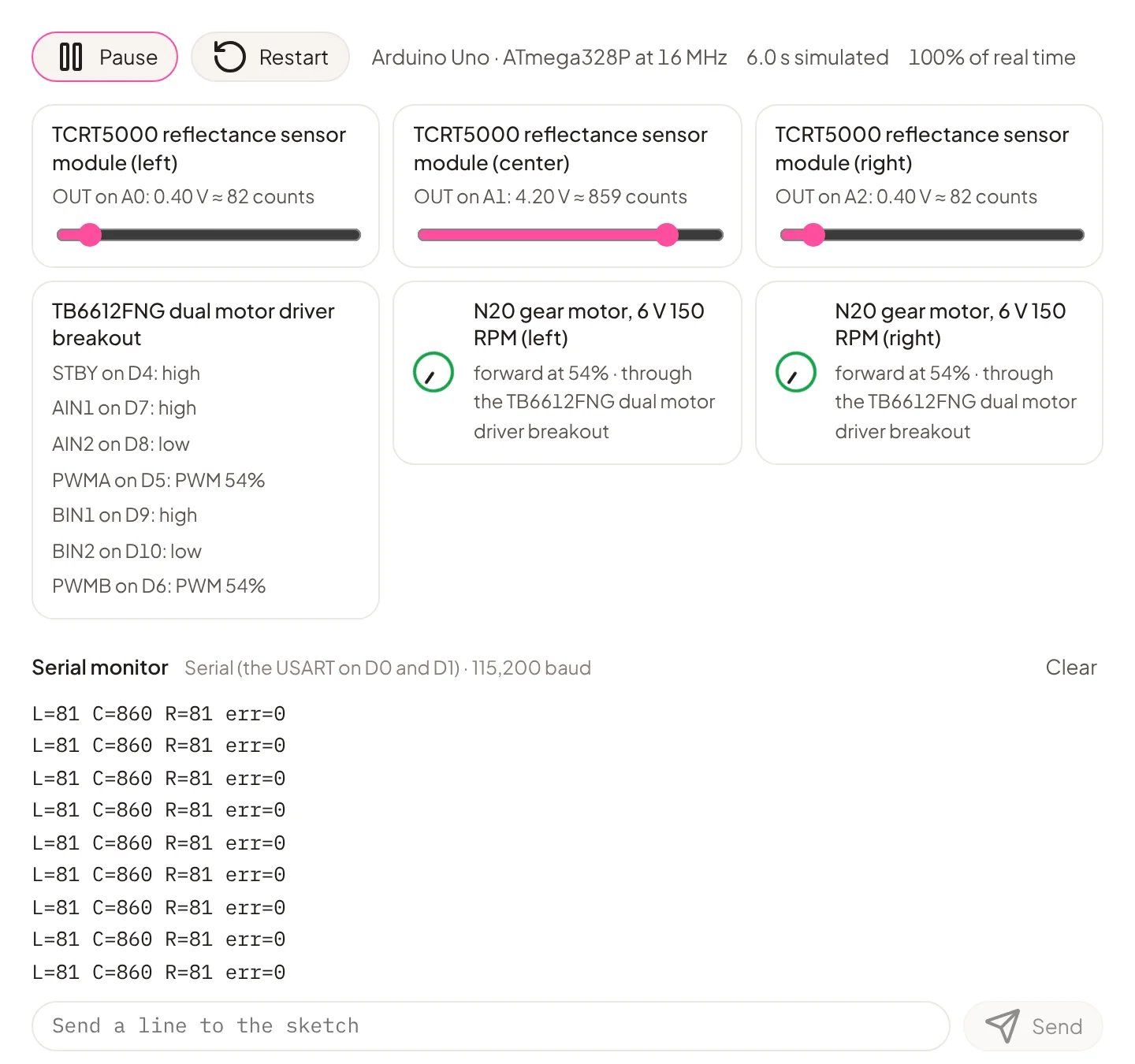
The other half of this matters just as much, and that's honesty. A simulator doesn't know what your motor does at stall. An emulator has no Wi-Fi radio. A check that reads parts by their names can be wrong. In hardware, an AI that is wrong and sure of itself does much more damage than one that is wrong and says so. Every result should say what it covered and what it didn't, and when a tool couldn't run, it should say that instead of handing you a file that only looks finished. “Not checked” is useful information. A confident guess is worse than useless, because you'll order parts based on it.
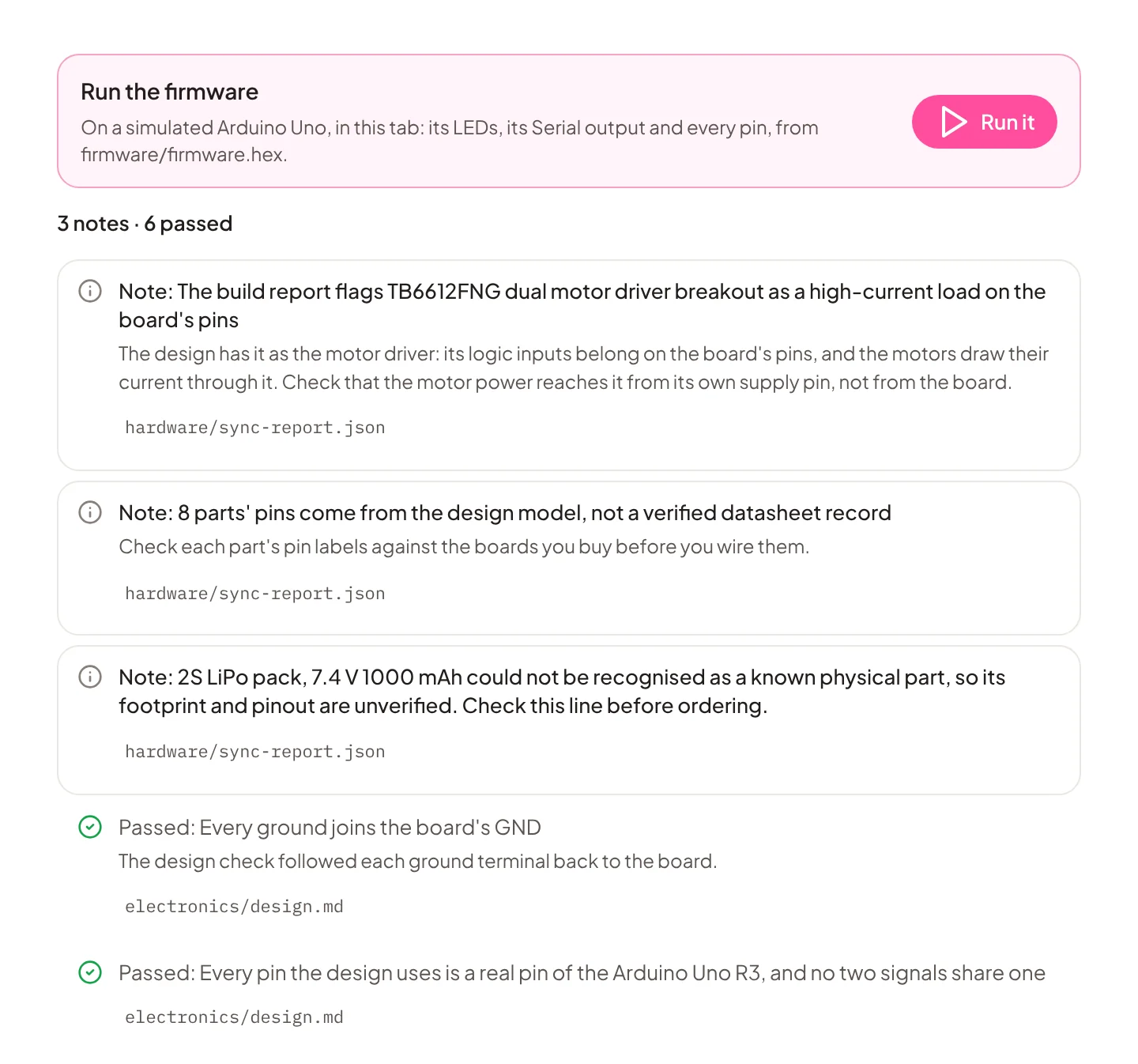
None of this turns hardware into software. Parts still take a week to arrive, and you still hold your breath the first time you power something on. That's why the loop can't end when the box arrives. On the bench you can finally compare what you predicted with what you measure, using a logic analyzer and a power supply whose current limit is set before its voltage. Those measurements feed back, so the next revision starts from what actually happened rather than what we hoped would happen.
Still, most of the mistakes in a hardware project aren't exotic. They're the same twenty mistakes, made again by someone new. My guess is that most of them can be caught in the two-second part of the loop, though not all.
There's a bigger reason I care about this loop. Physical AI is supposed to be the next mainstream thing. You hear it from chip companies and from investors putting billions into humanoid robots. But look at how people who build physical things actually work today, whether they're students or engineers at small hardware startups, and very little has changed. They still read datasheets and forum threads, draw schematics in tools made for professionals, and then wait two weeks to find out if they were right. Software had a moment in the last two years when this changed completely. Tools like Lovable let someone with no engineering background describe an app in a sentence and have a working one a few minutes later, and Lovable reportedly reached $100 million in annual revenue within about eight months of launch. The models had been decent at code for a while before that. What changed was that someone wrapped them in a loop short enough that the person in it no longer had to be an engineer. Physical AI is supposed to be mainstream, and it still hasn't had its vibe-coding moment.
I think that leaves room for a company like Lovable, built for things you can hold. The pieces finally exist. Models can write firmware and reason about circuits well enough to be useful. The professional tools all run from a command line: the compiler that builds an Arduino sketch, KiCad for circuit boards, OpenSCAD for parts, SPICE for circuits. That means they can run in the cloud behind a chat window. Boards like the Uno, the ESP32 and the Pico are standard enough to simulate, and a fab will make five circuit boards for a few dollars. What's missing is the product that ties these into one loop. You describe the device and get the design, the firmware, the board and the enclosure, already checked and simulated, with the files ready to order, and you can press Run and watch the firmware work before anything ships. The playbook can be Lovable's. Start with people who couldn't build at all before, get them to a first working thing in minutes rather than weeks, and stay with them as their projects get serious. What's different is what it takes to earn their trust. In software a wrong answer costs a retry. In hardware it costs parts and weeks, so I'd expect the winner to be the company whose checks people believe. A good-looking board won't be enough.
That's the bet we're making with Hardbot. You can't make parts ship faster from Shenzhen. But you can make sure the design in the box has already failed, in simulation, in every way it was going to.
Hardware is hard. It should be hard for the right reasons.